
Mobile Doctor vs. Traditional Primary Care: Which Option Is Right for You?
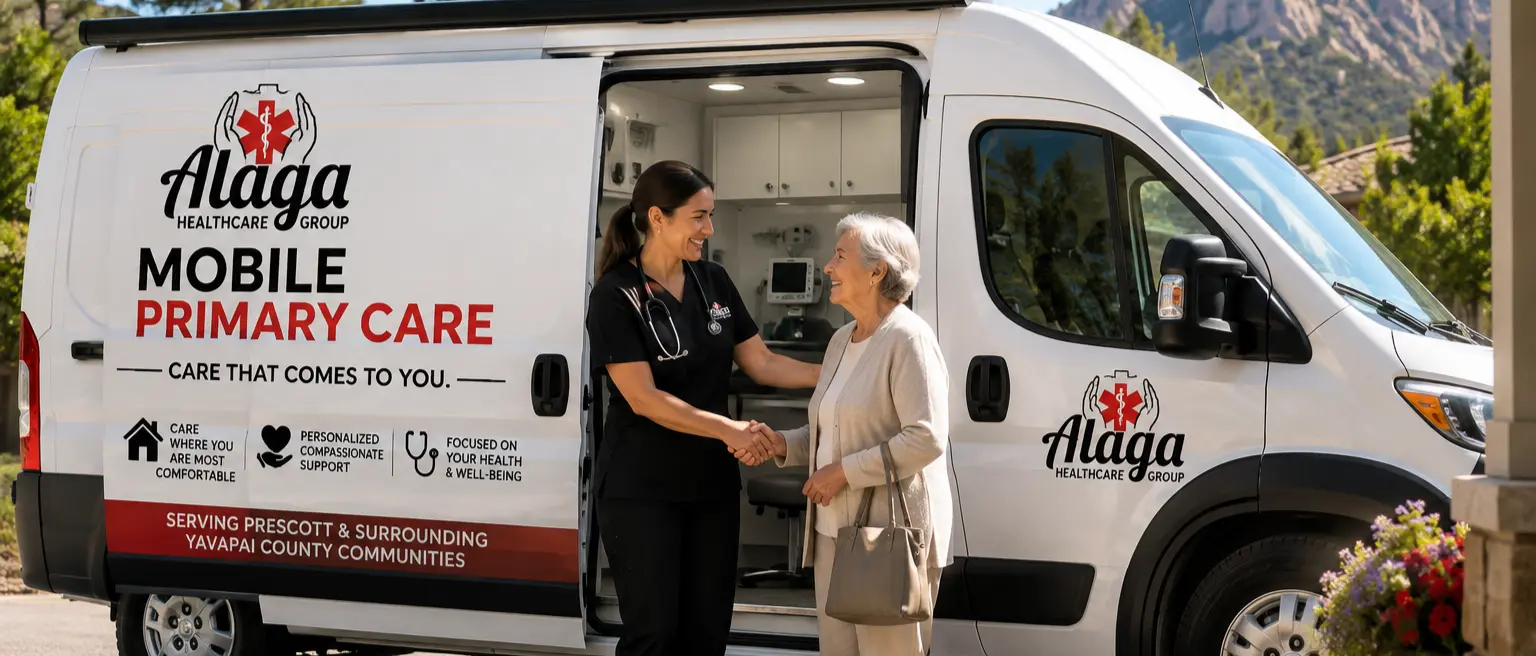
For many Prescott residents, getting medical care is not only about choosing a provider. Transportation, mobility, caregiving responsibilities, recovery after a hospital stay, and the effort required to leave home can all shape that decision. For older adults and people with limited mobility in Yavapai County, the choice between a mobile doctor and traditional primary care can have a meaningful impact on how convenient routine care feels.
Quick answer: A mobile doctor may be the better option when traveling to a medical office is difficult, exhausting, or disruptive, while traditional primary care may work well for patients who can comfortably attend office appointments and prefer access to an established clinic setting. The right choice depends on your health needs, mobility, transportation, preferred care environment, and the services available from the provider.
What local patients and families should know
-
Mobile medical care brings eligible healthcare services to the patient’s residence, reducing the need to travel to an office.
-
Traditional primary care takes place in a clinic or medical office where the provider has immediate access to that location’s staff, equipment, and resources.
-
Prescott residents who have mobility or transportation challenges may find home-based visits more convenient.
-
Families throughout Yavapai County may also consider how much assistance a loved one needs before, during, and after an office appointment.
-
Mobile care and office-based primary care are not necessarily interchangeable for every medical need, so patients should ask what services a provider can safely offer at home.
Why Does the Choice Between Mobile and Traditional Primary Care Matter in Prescott?
The choice matters in Prescott because the practical work of getting to an appointment can be very different from one patient to another. A person who drives independently and moves comfortably may have little difficulty visiting a clinic, while someone who relies on a caregiver, mobility device, or transportation assistance may face a much larger burden.
Prescott and the surrounding communities of Prescott Valley, Chino Valley, Dewey-Humboldt, and other parts of Yavapai County include patients with a wide range of living arrangements and transportation needs. Even an appointment that seems routine can involve getting dressed, transferring into a vehicle, traveling across the area, navigating a parking lot, and waiting in a medical office.
Alaga Healthcare LLC/Alaga Home Care and Hospice serves people seeking healthcare and support options in the area. When discussing care with us, patients and families can focus not only on medical needs but also on how care fits into everyday life.
What Are Mobile Doctor Visits?
Mobile doctor visits provide medical care at a patient’s residence rather than requiring the patient to travel to a traditional medical office. The exact services available during a home visit depend on the provider, the patient’s needs, and what can appropriately and safely be handled outside a clinic or hospital.
For some local residents, the biggest benefit is accessibility. A home visit can remove several logistical steps associated with an office appointment.
This may be particularly useful for someone who has difficulty walking, tires easily during outings, depends on another person for transportation, or finds leaving home challenging. Patients and families should confirm which examinations, treatments, testing, and follow-up services are available through a specific mobile provider.
What Does Traditional Primary Care Offer?
Traditional primary care provides routine and ongoing medical care in a clinic or office equipped for in-person appointments. This model can be a practical choice for Prescott patients who travel comfortably and value receiving care in a dedicated medical setting.
An office may have staff, diagnostic resources, and equipment readily available at the same location. Depending on the practice, this can make certain examinations, tests, or procedures easier to coordinate.
Traditional care also works well for many independent patients who already have an established routine with a primary care office. The main consideration is whether getting to and from that office remains manageable.
Who May Benefit From a Mobile Doctor?
A mobile doctor may be especially helpful for patients whose health, mobility, transportation, or caregiving circumstances make office visits difficult. Convenience alone can be valuable, but the larger benefit is often removing barriers that make receiving routine care harder.
Possible signs that home-based medical care is worth exploring include:
-
Leaving home requires substantial physical effort.
-
A patient depends on a family member or caregiver for transportation.
-
Walking through parking areas or medical buildings is difficult.
-
Mobility equipment makes transportation more complicated.
-
Office visits require significant planning by family caregivers.
-
A patient is recovering and currently has difficulty traveling.
-
Transportation limitations contribute to difficulty attending appointments.
These circumstances do not automatically mean mobile care is appropriate. A healthcare provider should determine whether the patient’s medical needs can be safely addressed in the home.
When Is Traditional Primary Care the Better Fit?
Traditional primary care may be the better fit when a patient can travel comfortably and needs or prefers services that are readily available in an office setting. Some medical concerns require testing, equipment, procedures, imaging, specialist evaluation, or emergency services that cannot be provided through a routine home visit.
Patients should seek the appropriate level of care for their symptoms rather than choosing home care solely for convenience. A mobile doctor is not a substitute for emergency medical services.
For Prescott residents who are independent, comfortable driving or arranging transportation, and satisfied with their existing office-based care, there may be no practical reason to change.
What Should Families Watch for When Office Visits Become Difficult?
Families should watch for increasing physical strain, transportation problems, caregiver burden, or missed appointments that make office-based care harder to maintain. These practical warning signs can indicate that it is time to ask whether another care arrangement is available.
A family member may notice that a loved one takes much longer to prepare for appointments, becomes exhausted by outings, or increasingly depends on others to coordinate transportation. Another warning sign is postponing routine appointments because getting to the office feels overwhelming.
For families in the Prescott area, recognizing these changes early can create more time to explore appropriate options rather than waiting until transportation becomes a major obstacle.
How Can Local Families Compare Their Options?
Local families can compare mobile and traditional primary care by looking at medical needs, travel ability, caregiver availability, and the type of services required. The best option is the one that safely meets the patient’s needs while making ongoing care realistically accessible.
| Consideration | Mobile Doctor | Traditional Primary Care |
|---|---|---|
| Location | Patient’s residence | Clinic or medical office |
| Travel required | Usually reduced for the patient | Patient travels to the office |
| Mobility concerns | May reduce transportation challenges | May require navigating vehicles, parking, and the clinic |
| Caregiver logistics | May simplify appointment transportation | Caregiver may need to provide or arrange transportation |
| Equipment and services | Limited to what can appropriately be provided in the home | Office resources are available on site |
| Best fit | Patients whose needs can be addressed at home | Patients comfortable attending an office or needing office-based resources |
Neither model is automatically better. The patient’s individual circumstances should guide the decision.
What Are Common Mistakes When Choosing a Care Model?
The most common mistake is choosing based only on convenience without considering the patient’s actual medical and practical needs. Prescott families can make a more informed choice by discussing both health requirements and day-to-day barriers with an appropriate healthcare provider.
Mistake: Assuming every service can be provided at home.
Consequence: A patient may expect testing or treatment that requires another setting.
Better approach: Ask exactly what a mobile provider can and cannot perform during a home visit.
Mistake: Waiting until transportation becomes unmanageable.
Consequence: Families may have fewer convenient options when an appointment is already needed.
Better approach: Explore alternatives as soon as routine office trips become noticeably harder.
Mistake: Treating mobile care as emergency care.
Consequence: A serious or urgent condition may not receive the level of response it requires.
Better approach: Use emergency services for medical emergencies and ask providers where urgent concerns should be addressed.
What Is a Common Local Scenario?
A common Prescott-area scenario involves an older adult who can remain at home but increasingly depends on family members for transportation to medical appointments. A single office visit may require a relative to change a work schedule, help the patient prepare, assist with transportation, and remain with them throughout the trip.
In a situation like this, the family might ask whether some appropriate medical visits can take place at home. If they can, mobile care may reduce transportation demands while allowing the patient to receive eligible services in familiar surroundings.
This is a general scenario, not a specific patient case.
What Healthcare Solutions Should Patients Explore?
Patients should explore the combination of medical and supportive services that best matches their health status, independence, and living situation. Home-based medical care may be one part of a broader conversation about support at home.
At Alaga Healthcare LLC/Alaga Home Care and Hospice, we encourage patients and families to ask questions about available care options, what can be provided at home, and when another medical setting is more appropriate.
Contact us to learn more about available care options
What Can Happen When Changing Care Needs Are Ignored?
Ignoring growing difficulty with medical appointments can make routine care harder to coordinate and place additional demands on patients and caregivers. A transportation challenge that begins as an inconvenience can become a significant obstacle when mobility changes or family assistance becomes less available.
Families do not need to wait for appointments to become unmanageable before asking about alternatives. Reviewing care options earlier can help everyone understand what resources may be available in Prescott and surrounding Yavapai County communities.
Frequently Asked Questions About Mobile Doctors in Prescott
Is a mobile doctor the same as a traditional primary care doctor?
Not necessarily. “Mobile doctor” describes how and where care is delivered, while primary care describes a type of ongoing healthcare. The qualifications, services, and scope of a particular provider can vary. Prescott patients should ask the provider what services are offered at home and how ongoing medical needs are managed.
Who should consider a mobile doctor in Prescott?
Patients who have difficulty traveling to medical offices may want to explore mobile care. This can include people with mobility challenges, transportation limitations, or substantial dependence on caregivers for appointments. Whether home-based medical care is appropriate still depends on the patient’s individual medical needs and the services the provider offers.
Can every medical appointment be handled at home?
No, not every medical need can necessarily be handled through a home visit. Certain tests, procedures, imaging services, specialist evaluations, urgent treatment, or emergency care may require another setting. Patients in Yavapai County should ask their provider which services are appropriate for home-based care and where other needs should be addressed.
Is mobile medical care only for older adults in Prescott?
No, age alone does not determine whether mobile medical care is appropriate. A person’s mobility, health needs, transportation situation, and ability to attend office appointments can all matter. Patients and families should discuss their circumstances directly with a healthcare provider before deciding whether home-based visits are suitable.
Can mobile doctor visits make things easier for family caregivers?
They may reduce some transportation and scheduling demands when home visits are appropriate for the patient. For a caregiver who normally helps someone travel from Prescott, Prescott Valley, Chino Valley, or another nearby community to appointments, eliminating some trips may simplify logistics. The actual benefit depends on the patient’s care plan.
What should I ask before choosing a mobile healthcare provider?
Ask about services, provider qualifications, scheduling, coverage area, costs or insurance arrangements, after-hours procedures, and situations that require office or hospital care. Patients should also understand how records, follow-up care, testing, prescriptions, and referrals are handled. Getting clear answers makes it easier to compare mobile care with an existing primary care arrangement.
Does a mobile doctor replace emergency care?
No, routine mobile medical care should not be treated as a replacement for emergency services. A potentially life-threatening or severe medical problem requires the appropriate emergency response. Prescott-area patients should follow emergency guidance for urgent situations rather than waiting for a routine home visit.
Does Alaga Healthcare serve areas outside Prescott?
Service availability should be confirmed directly with our team for each location and type of care requested. Prescott Valley, Chino Valley, Dewey-Humboldt, and other Yavapai County communities are nearby, but patients should not assume that every service is available in every area without first confirming current coverage.
Find a Care Option That Fits Life in Prescott
Choosing between a mobile doctor and traditional primary care is ultimately about matching the care setting to the patient’s medical needs and everyday circumstances. For local patients facing mobility, transportation, or caregiver challenges, learning about home-based options can be a useful next step.
Explore More Accessible Care Options in Prescott
We can help you learn more about available care options and determine what questions to ask based on your situation.